
What Is APQP? A Practical Guide to Advanced Product Quality Planning
Learn what APQP is, why it's essential for successful product launches, and how the five APQP phases help manufacturers improve quality, reduce risk, and ensure consistent production with a structured product development process.
Last Updated: 26 Jun 2026
Launching a new product is exciting. It's also risky.
In manufacturing, a single missed requirement can lead to production delays, customer complaints, expensive rework, or even product recalls. That's why automotive and industrial manufacturers rely on a structured approach to quality planning before production begins.
One of the most widely used methods is APQP.
If you've been wondering what is APQP, how it works, and why manufacturers around the world rely on it, giving you a practical understanding of the process.
Whether you're a quality engineer, project manager, manufacturing leader, or someone new to automotive quality systems, understanding APQP is essential for delivering successful products consistently.
What Is APQP?
APQP (Advanced Product Quality Planning) is a structured method used to plan, develop, validate, and launch new products.
The goal is simple:
Ensure the product meets customer requirements before full-scale production begins.
Instead of waiting until the end of a project to identify quality problems, APQP helps teams identify risks early and address them before they become expensive issues.
Think of APQP as a roadmap for new product development.
It guides teams through planning, design, process development, validation, and continuous improvement.
Today, APQP is widely used across:
- Automotive manufacturing
- Auto component manufacturing
- Aerospace
- Industrial equipment manufacturing
- Electronics production
- Heavy engineering
APQP Full Form
The APQP full form is:
Advanced Product Quality Planning
Each word has a purpose:
| Term | Meaning |
|---|---|
| Advanced | Planning ahead instead of reacting later |
| Product | The part, assembly, or system being developed |
| Quality | Meeting customer and regulatory requirements |
| Planning | Creating a structured path to production |
The focus is not just quality inspection.
The focus is quality by design - preventing defects through planning, not detecting them through inspection.
Why Was APQP Created?
Imagine an automotive supplier receives an RFQ for a new brake component.
Engineering starts designing the part.
Production begins planning tooling.
Purchasing contacts suppliers.
Quality prepares inspection plans.
Everyone is busy.
But what happens if the design team changes a specification halfway through the project and nobody informs production?
Or what if the tooling cannot achieve the required tolerance?
Or if the supplier cannot deliver material on time?
Without a structured process, problems like these are common.
APQP was created to prevent exactly these situations.
It ensures every department works together from the beginning of the project.
Instead of discovering issues during production, teams identify and solve them during planning.
Why APQP Matters Today
Modern manufacturing is more complex than ever.
Products contain more components.
Customers expect higher quality.
Regulatory requirements continue to increase.
At the same time, companies are under pressure to launch products faster. APQP helps organizations balance all these demands.
Companies that follow a disciplined APQP process often see:
- Fewer quality issues
- Better collaboration
- Faster product launches
- Reduced rework
- Improved customer satisfaction
- Stronger audit readiness
The APQP Process Explained
The APQP process follows five structured phases.
Each phase has defined activities, reviews, and deliverables.
The output of one phase becomes the input for the next.
APQP Process Flow
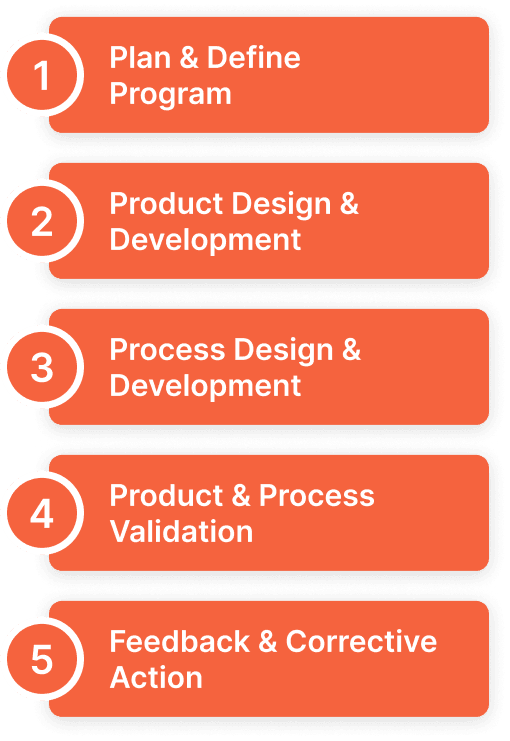
Plan & Define Program -> Product Design & Development -> Process Design & Development -> Product & Process Validation -> Feedback & Corrective Action
The 5 APQP Phases
Let's explore the five official APQP phases.
Phase 1: Plan and Define Program
Every successful project starts with planning.
This first phase focuses on understanding customer expectations and determining whether the organization can successfully deliver the product.
Key Activities
- RFQ review
- CFT Formation
- Customer requirement and Contract review
- Technical feasibility assessment
- Commercial feasibility assessment
- Risk identification
- Quotation Management
- Project planning (including APQP Timing plan)
Deliverables
- Approved project plan
- Feasibility report
- Risk register
- Cross-functional team structure
- Quotations
- APQP Timing plan
Key Documents
| Document | Purpose |
|---|---|
| RFQ | Defines customer requirements |
| Feasibility Checklist | Evaluates project viability |
| Project Timing Plan | Establishes milestones |
| Risk Assessment | Identifies potential issues |
Validation Tools
- Feasibility Reviews
- Management Gate Reviews
- Risk Assessment Workshops
A strong Phase 1 often prevents problems later in the project.
Phase 2: Product Design and Development
Once planning is complete, the focus shifts to the product itself.
The objective is to create a design that satisfies customer requirements while remaining practical to manufacture.
This phase involves close collaboration between engineering, quality, and manufacturing teams.
Key Activities
- Design reviews
- Customer drawing reviews
- Prototype development
- DFM analysis
- DFA analysis
- Engineering validation
Deliverables
- Approved product design
- Engineering drawings
- Product specifications
- Design FMEA
- Prototype Control Plan
- DVP&R Document
Key Documents
| Document | Purpose |
|---|---|
| CAD Models | Product definition |
| Design FMEA | Design risk analysis |
| Product Specifications | Customer requirements |
| Drawing Packages | Manufacturing reference |
Validation Tools
- Design Reviews
- Prototype Testing
- Design Verification
At this stage, teams ask:
Can this product be manufactured consistently and economically?
The earlier these questions are answered, the fewer surprises occur later.
Phase 3: Process Design and Development
A great product design means little if the manufacturing process cannot produce it reliably.
That is why Phase 3 focuses on developing the production process.
This is often one of the most important stages of APQP.
Key Activities
- Process flow development
- Manufacturing resource planning
- Tooling and fixture design
- PFMEA workshops
- Control Plan development
- Work instruction creation
- Packaging and logistics planning
- Operator training planning
Deliverables
- Process Flow Diagram
- Resource Plan
- Process FMEA (PFMEA)
- Pre launch Control Plan
- Packaging Standards
- Work Instructions
- MSA Plan
- Trial Run Reports
Key Documents
| Document | Purpose |
|---|---|
| Process Flow Diagram | Maps manufacturing sequence |
| PFMEA | Identifies process risks |
| Control Plan | Defines controls and inspections |
| Work Instructions | Guides operators |
Validation Tools
- PFMEA Reviews
- Process Readiness Assessments
- Manufacturing Feasibility Reviews
- Control Plan Reviews
- Cross-Functional Design Reviews
The goal is to build a stable process before production begins. Note that the Control Plan is not a one-time document, it evolves across Phases 3 and 4, progressing from a Pre-Launch Control Plan to the final Production Control Plan used in ongoing manufacturing.
Phase 4: Product and Process Validation
Now it is time to prove everything works.
Phase 4 validates both the product and the manufacturing process.
This is where organizations confirm they can consistently produce parts that meet customer requirements.
Key Activities
- PPAP preparation and submission
- Product audits
- Process audits
- Measurement System Analysis (MSA)
- Statistical Process Control (SPC) implementation
- Capability studies
- Pilot production runs
- Customer approval activities
Deliverables
- Approved PPAP package
- Audit reports
- Process capability results
- Audit findings
- Customer approvals
- Production Control Plan
- SOP Declaration
- 8D and NC Reports
Key Documents
| Document | Purpose |
|---|---|
| PPAP Package | Demonstrates production readiness |
| Process Capability Reports | Measures process performance |
| MSA Studies | Validates measurement systems |
| SPC Records | Monitors process stability |
| Product Audit Reports | Confirms product conformity |
Validation Tools
- PPAP
- SPC
- MSA
- Process Capability Studies (Cp/Cpk)
- Product Audits
- Process Audits
- Pilot Production Runs
Validation helps reduce the risk of quality problems after launch. Instead of hoping the process works, teams generate evidence that it does.
Phase 5: Feedback, Assessment and Corrective Action
Many people think APQP ends once production starts.
In reality, the final phase focuses on continuous improvement.
Manufacturers collect feedback, evaluate performance, and implement corrective actions where necessary.
Key Activities
- Customer feedback analysis
- Warranty and field failure reviews
- Root cause investigations
- Corrective and Preventive Action (CAPA) management
- Lessons learned workshops
- Process performance reviews
- Continuous improvement initiatives
Deliverables
- CAPA records
- Improvement action plans
- Customer feedback reports
- Lessons learned repository
- Production handover documentation
- Continuous improvement roadmap
Key Documents
| Document | Purpose |
|---|---|
| CAPA Reports | Tracks corrective and preventive actions |
| Customer Feedback Reports | Captures customer concerns and opportunities |
| Warranty Analysis Reports | Identifies field performance issues |
| Root Cause Analysis Reports | Documents investigation findings |
| Lessons Learned Records | Preserves organizational knowledge |
| Performance Dashboards | Tracks ongoing KPIs |
The objective is simple: Make the next product launch even better than the last one.
Stages of APQP at a Glance
The five stages of APQP can be summarized as follows:
| Phase | Objective |
|---|---|
| Phase 1 | Understand requirements and assess feasibility |
| Phase 2 | Develop and validate product design |
| Phase 3 | Design manufacturing processes |
| Phase 4 | Documents investigation findings |
| Phase 5 | Preserves organizational knowledge |
Key APQP Documents
Documentation is a major part of APQP.
These records help maintain traceability and demonstrate compliance during audits.
Some commonly used APQP documents include:
Planning Documents
- RFQ records
- Feasibility studies
- Timing plans
- Project plans
Design Documents
- Drawings
- Specifications
- Design FMEA
- Review records
Process Documents
- Process Flow Diagrams
- PFMEA
- Control Plans
- Work Instructions
Validation Documents
- PPAP submissions
- MSA studies
- Capability reports
- Audit findings
Managing these documents manually becomes increasingly difficult as projects grow in complexity.
APQP vs PPAP: What's the Difference?
Many people confuse APQP and PPAP.
They are related, but they are not the same.
| APQP | PPAP |
|---|---|
| Complete planning methodology | Approval process |
| Covers entire product development lifecycle | Occurs during validation |
| Focuses on planning and execution | Focuses on customer approval |
| Five phases | One important deliverable |
A simple way to think about it: APQP is the journey. PPAP is one milestone along that journey.
Common APQP Challenges
Even experienced manufacturers struggle with APQP execution. Some common challenges include:
Spreadsheet Dependency
Information becomes scattered across multiple files and departments.
Missed Deadlines
Manual tracking makes it easy to overlook critical milestones.
Poor Visibility
Managers often lack real-time insight into project status.
Version Control Problems
Teams may work from outdated documents.
Supplier Coordination Issues
External stakeholders may not have access to current information.
These issues become more severe as organizations manage multiple product launches simultaneously. Many manufacturers report challenges with fragmented communication, manual document tracking, and maintaining traceability throughout the APQP lifecycle.
How Digital APQP Systems Help
As product development becomes more complex, many organizations are moving away from spreadsheets and email-based tracking.
Digital APQP platforms centralize information and improve visibility across teams.
Benefits include:
- Automated workflow management
- Real-time status tracking
- Approval workflows
- Document version control
- Audit readiness
- Supplier collaboration
- Dashboard reporting
For example, Protrak's APQP Management Solution digitizes the complete APQP lifecycle—from RFQ management and feasibility reviews to PPAP, validation, CAPA, and reporting. The platform provides phase-wise tracking, automated alerts, document control, and real-time dashboards to improve collaboration and reduce manual effort.
You can learn more about the solution here.
APQP and IATF 16949
If you work in automotive manufacturing, you've probably encountered IATF 16949.
While APQP is not a certification standard, it plays an important role in supporting compliance. In particular, IATF 16949 Clause 8.3 (Design and Development of Products and Services) directly maps to APQP activities, making a well-structured APQP process a practical foundation for meeting that requirement.
Many IATF 16949 requirements focus on:
- Risk management
- Process control
- Continuous improvement
- Defect prevention
- Customer satisfaction
A well-executed APQP process helps organizations meet these expectations consistently.
Benefits of APQP
When implemented correctly, APQP delivers measurable business value.
Quality Benefits
- Reduced defects
- Improved consistency
- Better first-time-right performance
Operational Benefits
- Faster launches
- Reduced rework
- Better resource planning
Financial Benefits
- Lower warranty costs
- Reduced scrap
- Improved profitability
Customer Benefits
- Improved confidence
- Better delivery performance
- Higher satisfaction
The result is a more predictable and efficient product development process.
Final Thoughts
So, what is APQP?
It is a proven framework that helps manufacturers plan, develop, validate, and launch products successfully.
The APQP full form—Advanced Product Quality Planning—captures its purpose perfectly. It is about planning quality into a product long before production begins.
By following the five APQP phases, organizations can improve collaboration, reduce risk, strengthen compliance, and deliver better products to customers.
As manufacturing programs become increasingly complex, digital tools are also becoming an important part of the equation. Modern APQP platforms help organizations manage documentation, approvals, validation activities, and continuous improvement in a single system.
Whether you are launching your first automotive program or managing dozens of product introductions each year, mastering the APQP process and understanding the stages of APQP can significantly improve quality, efficiency, and business performance.
Mohammad Wasi
Solution Consultant
Mohammad Wasi is a Solution Consultant at Prorigo, specializing in Protrak’s Quality Management System (QMS) and Advanced Product Quality Planning (APQP) solutions. He works closely with customers to understand their business processes and translate requirements into practical, scalable solutions. Wasi has experience leading low-code and no-code transformation initiatives that simplify complex workflows and improve time-to-value. He designs and implements QMS and process automation solutions aligned with stakeholder goals, while also driving change management and user adoption. He collaborates with business and IT teams to translate strategic objectives into structured solution roadmaps and phased implementations, helping organizations improve compliance, process visibility, and overall quality performance.

Explore Protrak's APQP Management Solution
Digitize your complete APQP journey, from RFQ to production handover
- End-to-End APQP Lifecycle
- Phase Gate Tracking & Approvals
- PPAP & Document Management
- Real-time Dashboards & KPIs
- ERP, MES & Supplier Integration